-
 Workshop | Explainable AI for Stock Market PredictionGLASGOW, UK APRIL 18, 2023
Workshop Title:
Explainable AI for Stock Market Prediction
Date:
April 18th, 2023 (GMT+1)
Organizer:
Department of Computer and Information Sciences, University of Strathclyde
Keywords:
- Explainable AI
- Stock Market
- Machine learning
Workshop Chair:
Personal Bio:
Prof. Anil Fernando received the B.Sc. (Hons.) degree (First Class) in electronics and telecommunication engineering from the University of Moratuwa, Sri Lanka, in 1995, and the M.Sc. in Communications (Distinction) from the Asisan Institute of Technology, Bangkok, Thailand in 1997 and Ph.D. in Computer Science (Video Coding and Communications) from the University of Bristol, UK in 2001. He is a professor in Video Coding and Communications at the Department of Computer and Information Sciences, University of Strathclyde, UK. He leads the video coding and communication research team at Strathclyde. He has worked on major national and international multidisciplinary research projects and led most of them. He has published over 400 papers in international journals and conference proceedings and published a book on 3D video broadcasting. He has been working with all major EU broadcasters, BBC, and major European media companies/SMEs in the last decade in providing innovative media technologies for British and EU citizens. His main research interests are in Video coding and Communications, Machine Learning (ML) and Artificial Intelligence (AI), Semantic Communications, Signal Processing, Networking and Communications, Interactive Systems, Resource Optimizations in 6G, Distributed Technologies, Media Broadcasting and Quality of Experience (QoE).
Workshop Committee Members:
Mrs. Piyumi Perera, Researcher, Piyumi.Perera@strath.ac.uk
Workshop Description:
Background:
Stock market prediction has been an interesting yet challenging matter that has gained attention from economists and computer scientists since the 1990s. Especially in the current world, numerous data points influence the direction of the stock market. Hence, much research has been carried out on utilizing machine learning algorithms to make accurate predictions as it is impractical for a human to analyze relevant data and make timely trading decisions in this highly volatile marketplace. Even though many prediction models tend to produce promising results, traders are reluctant to accept the prediction without logical reasoning. Due to that, application of explainable AI in stock market predictions has become the new horizon in the area of study. This workshop focuses on providing a concise overview on prior research and an analysis on contemporary studies relating to the subject matter. Based on the analysis possible future direction in the study area is expected to be presented.
Goal / Rationale:
The stock market is a highly volatile marketplace where investors trade shares of publicly traded companies. The ability to make accurate prediction decisions is vital for investors to generate capital gains. But, due to the nonlinearity of the stock prices it is extremely difficult to make correct predictions consistently. Hence, investors tend to adopt AI methods and techniques to predict the future direction of stock markets. But as the AI models evolve in predictability they have become more rigid and 'black-boxes'. Therefore, investors are reluctant to accept the decisions made by an AI model. Currently, there's a growing interest in adopting explainable AI (XAI) in the finance field to x-ray the 'black-box' and generate reasoning for the predictions. This tutorial will address the problem on how XAI is currently impacting the stock market predictions.
Scope and Information for Participants:
The objective of this tutorial is to produce an overview on the historical development and current status of the AI application in stock price prediction while providing an understanding on the challenges and possible future direction in the field.
We expect to present our study providing a comprehensive overview on the historical development of AI algorithms in stock price prediction. In addition, through this tutorial it is expected to produce an in-depth overview on the kinds of algorithms that are currently utilized by researchers to generate next day price and price direction prediction based on numeric and textual data.
Highlights:
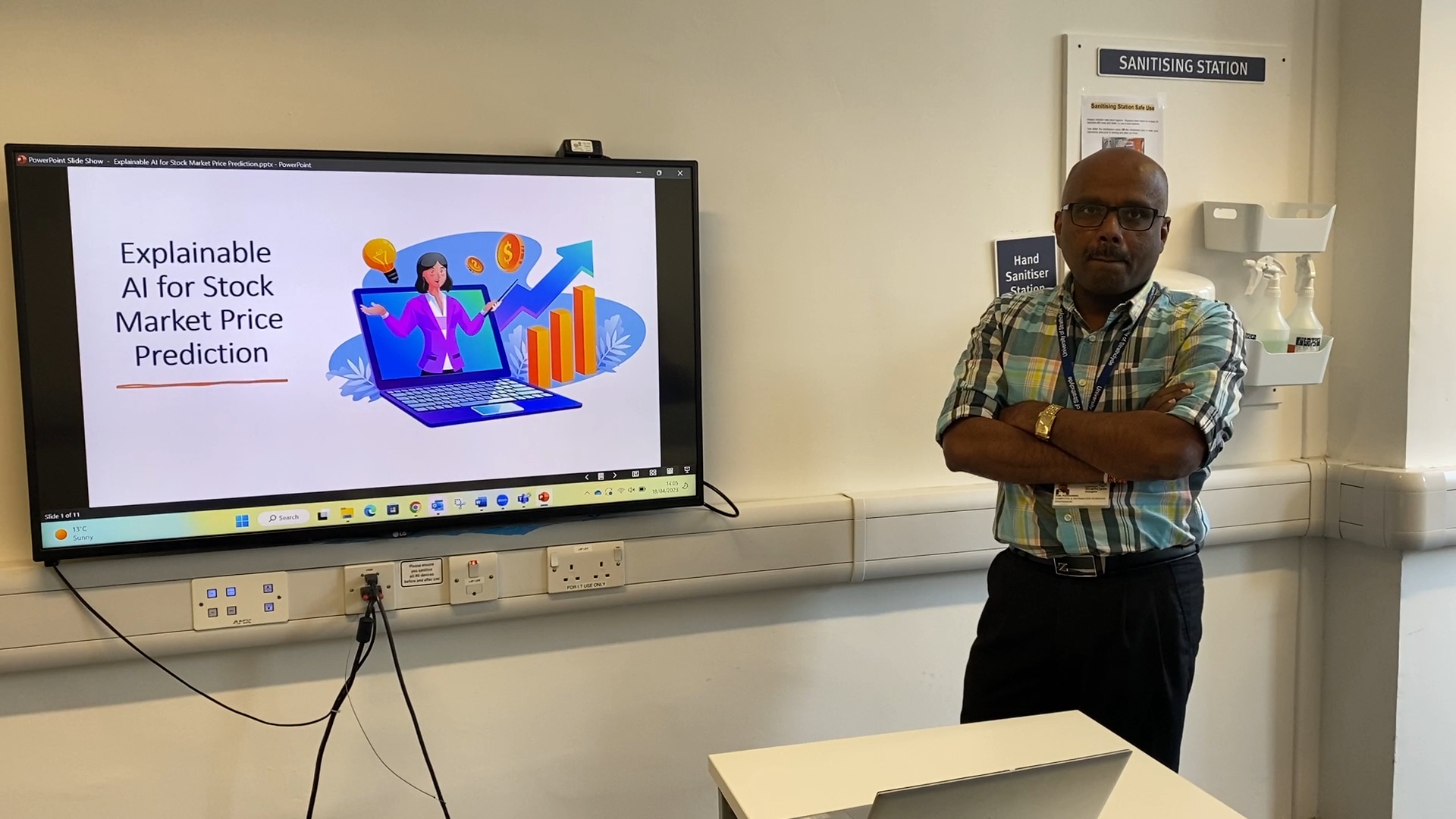
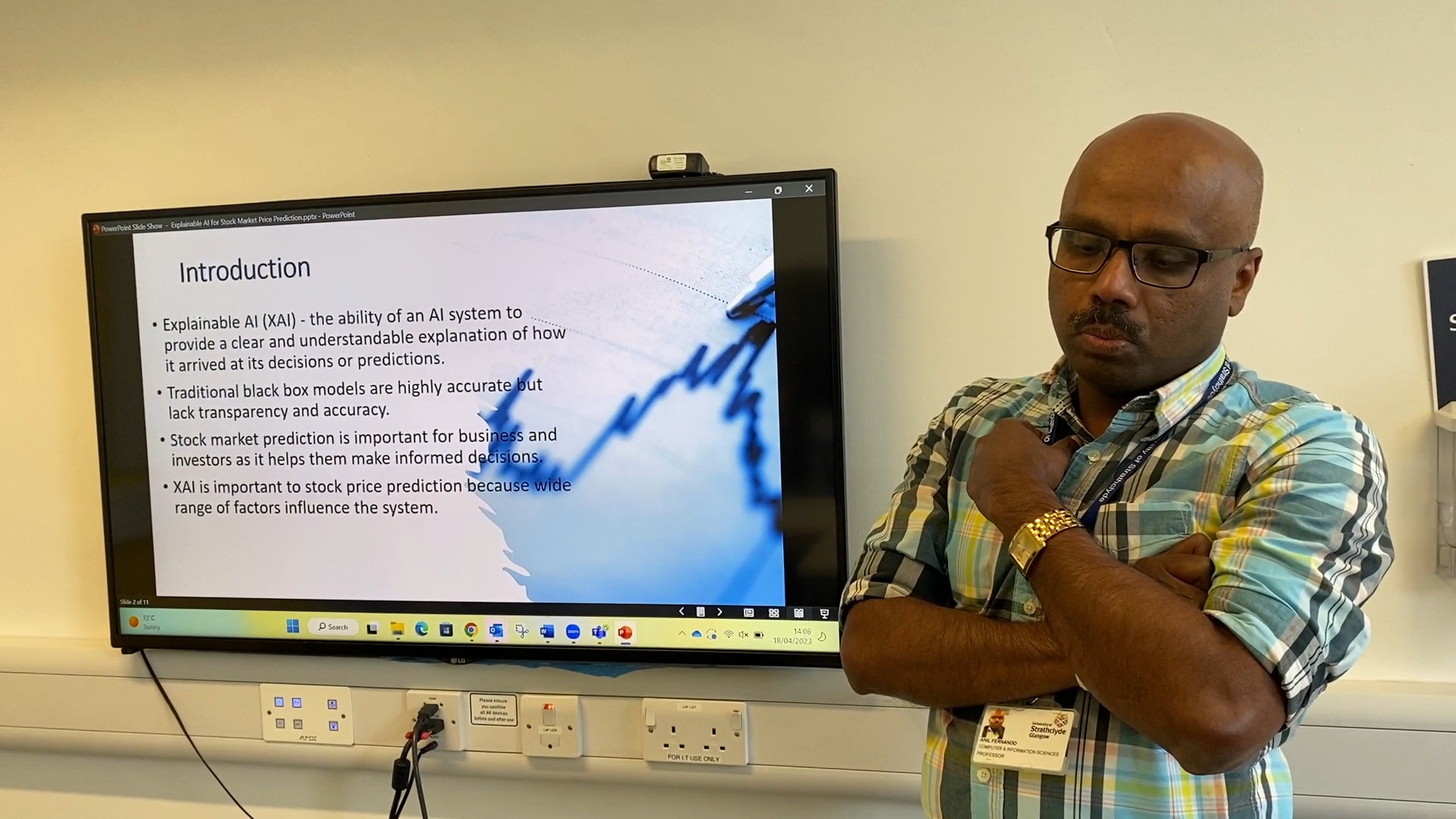

The stock market is a highly volatile marketplace where investors trade shares of publicly traded companies. The ability to make accurate prediction decisions is vital for investors to generate capital gains. But, due to the nonlinearity of the stock prices it is extremely difficult to make correct predictions consistently. Hence, investors tend to adopt AI methods and techniques to predict the future direction of stock markets. But, as the AI models evolve in predictability they have become more rigid and 'black-boxes'. Therefore, investors are reluctant to accept the decisions made by an AI model. Currently, there's a growing interest in adopting explainable AI (XAI) in the finance field to x-ray the 'black-box' and generate reasoning for the predictions. This workshop addresses the problem on how XAI is currently impacting the stock market predictions. It produces an overview on the historical development and current status of the AI application in stock price prediction while providing an understanding on the challenges and possible future direction in the field. We presented our study providing a comprehensive overview on the historical development of AI algorithms in stock price prediction. In addition, through this workshop it produced an in-depth overview on the kinds of algorithms that are currently utilized by researchers to generate next day price and price direction prediction based on numeric and textual data.
Access to Workshop:
CONF-SEML 2023 Workshop - Glasgow (1) - YouTube
CONF-SEML 2023 Workshop - Glasgow (2) - YouTube
Venue:
LT304, Department of Computer and Information Sciences, University of Strathclyde, Glasgow G1 1XQ, UK

VISA:
Welcome to GOV.UKIn order to ensure the information is correct and up to date, there may be changes which we are not aware of. And different countries have different rules for the visa application. It is always a good idea to check the latest regulations in your country. This page just gives some general information of the visa application.
UK Visa Information
What you need to do
- Check if what you plan to do in the UK is allowed as a Standard Visitor.
- Check you meet the eligibility requirements.
- Check if you need to apply for a visa to visit the UK.
- Apply for a Standard Visitor visa online - if you need one.
Check you meet the eligibility requirements
You must have a passport or travel document to enter the UK. It should be valid for the whole of your stay.
You must be able to show that:
- you'll leave the UK at the end of your visit
- you're able to support yourself and your dependants during your trip (or have funding from someone else to support you)
- you're able to pay for your return or onward journey (or have funding from someone else to pay for the journey)
- you'll not live in the UK for extended periods through frequent or successive visits, or make the UK your main home
Check if you need a visa to visit the UK
Depending on your nationality, you'll either:
- have to apply for a Standard Visitor visa before you travel to the UK
- be able to visit the UK for up to 6 months without needing a visa
You can check if you need a visa before you apply.
If you do not need a visa, you must still meet the Standard Visitor eligibility requirements to visit the UK. You may be asked questions at the UK border about your eligibility and the activities you plan to do.


Sometimes it is the people who no one imagines anything of, that do the things that no one can imagine.